Most people meet their first deck the same way. The cards sit on a shelf for a week, still in the plastic, waiting for the right evening that never quite arrives. Doing a tarot reading means settling on a question, drawing one or more cards, and reading their meanings against what is actually going on in your life. That is the whole shape of it. Everything else is preference, atmosphere, and practice.
You do not need permission to start. You need a quiet half hour and a willingness to sit with what comes up.
What you need to do a tarot reading
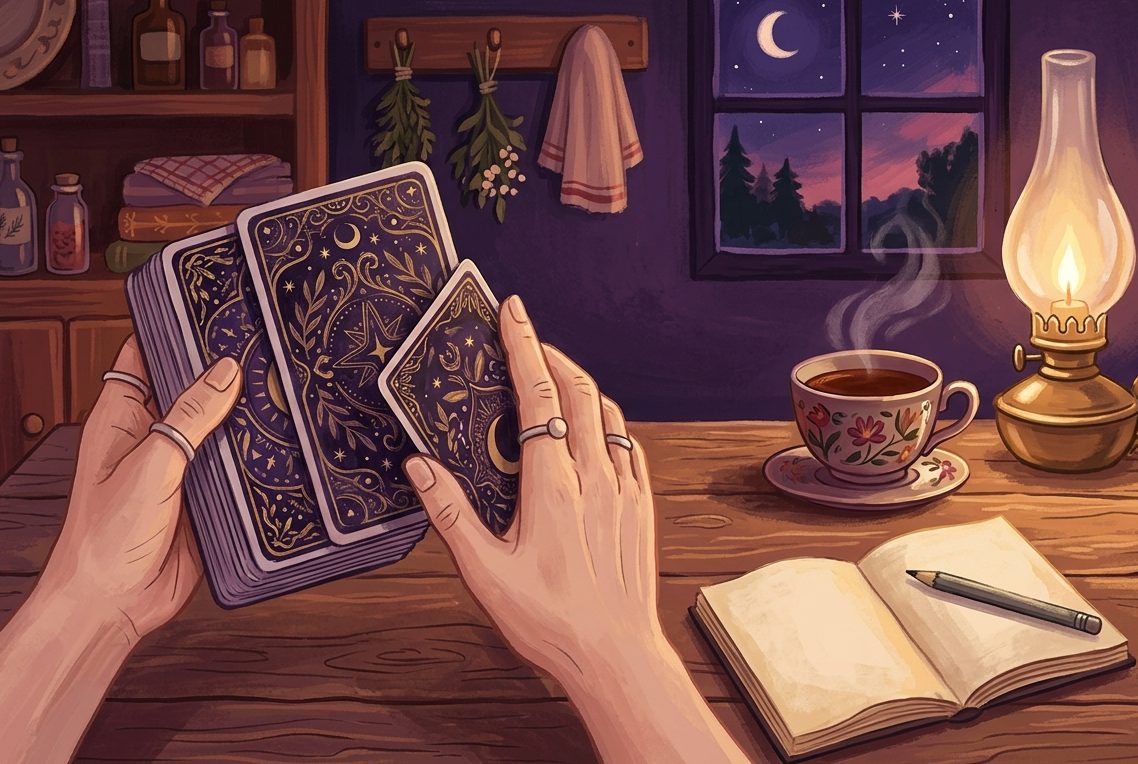
A deck. A few minutes where nobody will interrupt you. Something to write with, because you will forget what you thought a card meant by tomorrow.
That is the real list. The rest of what you may have heard is folklore that hardened into rules.
- Someone else has to gift you your first deck. They do not. Buy your own, and pick one whose pictures you like looking at.
- You need a silk cloth and a specific candle. You do not. A kitchen table works. So does a bed.
- You must cleanse the deck before touching it. Only if it means something to you. Shuffling is enough for most people.
If a ritual helps you slow down, keep it. If it only makes starting harder, let it go.
How to do a tarot reading step by step
- Settle the question. Vague questions get vague answers, so trade "what about my job" for something you could actually act on, like "what am I avoiding at work". Open questions beat yes or no ones while you are learning. There is more on shaping these in our guide to questions worth asking.
- Shuffle until it feels like enough. There is no correct number of shuffles. Hold the question loosely in your mind while your hands do the work, and stop when stopping feels natural. Some people cut the deck, some do not.
- Draw. Off the top, from the middle, or from a card that catches your eye as you spread them. Whichever way you choose, choose it before you start rather than after you see what came up.
- Look at the image before you reach for a meaning. This step gets skipped constantly and it teaches you the most. Notice who is in the picture, where they are looking, what the weather is doing. Your first reaction is information, even before you know the standard interpretation.
- Read the meaning against your situation. A card meaning is a starting point, not a verdict. The Three of Swords carries grief and painful clarity. Whether that points at a conversation you have been dreading or an old hurt you thought you were done with is something only you can place.
- Write a line or two down. The date, the question, the card, and one sentence about what you made of it. Weeks later these notes are the most useful thing you own, because they show you which readings landed and which ones you talked yourself into.
Getting to know the deck
A standard deck holds 78 cards in two groups. The 22 Major Arcana carry the big themes, the turning points and long arcs, cards like The Tower and The Star. The remaining 56 sit in four suits and cover daily life, which is where most of your questions will actually live. Cups deal with feelings and connection. Wands carry drive and creativity. Swords hold thought and conflict. Pentacles cover work, money, and the body. Knowing only that much lets you make sense of a card you have never seen before, and the full card meanings library is there for looking up anything you draw.
Reading for yourself honestly
Here is the part nobody warns beginners about. Reading for yourself is harder than reading for a friend, and not because the cards behave differently. You know too much. You already know which answer you want, and a deck of symbolic pictures is generous enough to give it to you if you push.
Three habits keep you honest.
Write the question down before you draw, word for word. It is remarkably easy to quietly revise the question once you see the cards, so that whatever appeared becomes the answer to something.
Read the uncomfortable card first. If one card makes your stomach drop a little, start there rather than saving it for last, where it tends to get softened into nothing.
Say the reading out loud, even alone. Interpretations that sound convincing in your head often fall apart the moment you hear yourself say them. That collapse is useful.
None of this means your instincts are wrong. Half the time you already know the answer and the cards are only giving you a way to admit it.
Which tarot spread to start with
One card. Genuinely. A single card is a complete reading, and it is the best possible practice because it forces you to sit with one image instead of building a story out of five. Pull one in the morning and see how it reads by evening.
When a question has more moving parts, the three card spread gives you enough structure without much complexity. Past, present, and future is the familiar version, though the positions can be anything you decide before you draw.
Larger layouts exist, and they can wait. There is no rush to arrive at ten cards.
Common beginner worries
Drawing a frightening card. Death, The Tower, and the Three of Swords look alarming and are not literal. Death means endings and change, the closing of a chapter. The cards describe what is moving in your life, not what is coming for you.
Reversed cards. When a card lands upside down, some readers read it differently and some ignore the orientation entirely. Both are fine. If you do read reversals, treat them as another angle on the same card, an invitation to look more closely rather than a negative verdict.
Doing it wrong. A reading you do for yourself is a conversation with yourself, held with pictures instead of words. You can misread a card and correct yourself later. You can draw again tomorrow. There is very little here to fail at.
One honest limit worth naming. Tarot cannot tell you what another person is thinking, and it cannot tell you what will happen next week. What it can do is lay out your own situation in a form clear enough to look at.
Common questions
Can I do a tarot reading on myself?
Yes, and most readers do it far more often than they read for anyone else. The only real difficulty is that you already know what you hope the cards will say, which makes it tempting to bend an interpretation toward that. Writing your question down before you draw, and reading the least comfortable card first, keeps a self reading closer to honest.
Do I need to memorize all 78 tarot card meanings first?
No. Start with one card at a time and look it up as you go. Learning the four suit themes gives you a reasonable guess at any card you have never seen, and the numbers carry their own pattern, with aces as beginnings and tens as completion. Memorization arrives on its own after enough readings. Nobody sits down and learns the deck first.
How often should I do a tarot reading?
Whatever rhythm keeps the readings meaningful. One card a day suits many people, since it is small enough to sustain and gives you steady practice. What tends not to work is asking the same question repeatedly until a better card shows up. If you feel that pull, the reading you already got probably said something you did not want to hear.
Learning as you go
Your early readings will feel clumsy, and that is simply what learning looks like. Keep the notebook. Come back to old entries after a month and see which cards you now understand better than you did.
Witch makes a good companion for exactly this kind of practice, a place to draw a card and think a reading through with someone rather than alone at the kitchen table.