
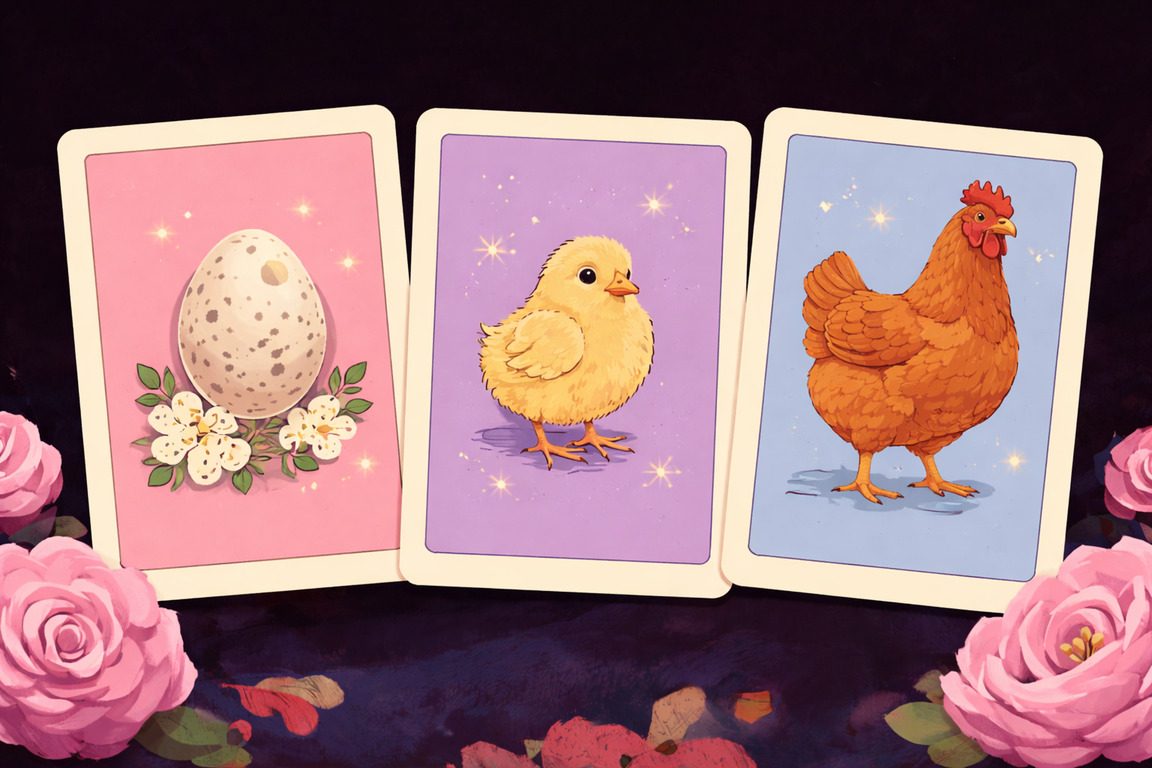
Three cards is enough to make a story and few enough to hold in your head at once. That is most of why this spread has outlasted the fancier ones. A three card tarot spread is a reading where you draw three cards and give each one a named position before you look. A single card gives you a mood. A ten card layout gives you homework. Three sits comfortably in between.
The best known version reads past, present, future. It is a good default, though the three slots will hold almost anything you name before you draw. What matters is deciding what each position means first, then letting the cards answer the question you actually asked.
How to do a three card tarot spread
- Pick a question you would genuinely like to think about. Open questions give the cards more to work with. "How can I support my friend right now" beats "will she call me".
- Name your three positions before you touch the deck. Past, present, future is fine. So is anything else, as long as you commit while the cards are still face down.
- Shuffle until it feels like enough. There is no correct number of shuffles. Stop when your hands stop fidgeting.
- Draw three cards and lay them left to right in the order you drew them. Turn them over one at a time, or all at once. Both work.
- Read each card against your question on its own. Then go back and read all three together, which is where most of the meaning lives.
Writing the question down before you draw is the single habit that improves these readings most. A question you can reread is a question you can be honest about.
What each position holds
The past card points to what brought you here. An old habit, an earlier decision, something someone said a year ago that you have not put down yet. It is not there to be judged. It is there so you can see which part of the situation is genuinely old.
The present card is a snapshot of where you stand today, including how you feel about standing there. People tend to skim this one because they assume they already know their own situation. It rewards slowing down. The present card often describes the thing you have been avoiding naming.
The future card shows where the current line seems to be heading, not where it has to go. Read it as a forecast you are allowed to change. If it looks difficult, it is showing what the present drifts toward when nothing shifts. If it looks kind, it is showing what your current care is already building.
A sample reading
Say the question is "How can I improve my relationship with my partner". It is open, it is about your own behavior, and it does not ask the cards to speak on someone else's behalf.
The draw: The Lovers reversed in the past, the Five of Cups in the present, the Two of Cups in the future.
The Lovers reversed in the past position often points to a choice made without both people fully in the room. Maybe a conversation got postponed so many times it turned into a habit. Reversed does not mean the relationship went wrong. It asks you to look again at the part of the story that got skipped.
The Five of Cups in the present sits with disappointment. Cups is the suit of feelings and connection, and the Five is the moment of counting what is missing. Right now your attention is on the spilled cups rather than the two still standing behind you. Naming that disappointment out loud, to yourself first, is usually the useful move.
The Two of Cups in the future is a card of meeting someone halfway. It is not a promise that things resolve. It shows what becomes available once the skipped conversation from the first card finally happens.
Reading three cards as one sentence
Beginners often read three cards as three verdicts and end up with three unrelated fortune cookies. The spread works better as one sentence with three parts.
Say it out loud in a single breath. Using the reading above: "The conversation we kept postponing left me counting what is missing, and a real meeting is available the moment I say the thing."
One sentence like that is worth more than three careful paragraphs. If you cannot build one, that is useful information too. It usually means the question was too broad, or that you have been reading the pictures instead of your own situation. A way in is to link the cards with small connective words like because, and yet, or so, then keep the connector that does not feel forced.
Other ways to name the three positions
Past, present, future is the default, not the rule. Renaming the positions changes what the same three cards are able to say.
Situation, obstacle, advice suits a practical stuck point. The first card describes what is actually happening, minus the story you have built around it. The second names what stands in the way, which turns out to be a habit more often than a person. The third is the card to sit with longest, since advice from a mirror only helps if you are willing to look.
You, them, the relationship works for anything shared, romantic or not. Read your own card honestly before you read theirs. The third card is the relationship itself, which has its own needs separate from either person in it. A common surprise here is that the third card is doing better than the first two.
Keep, release, invite fits the end of something. A month, or any stretch of life you are ready to close. The first card names what is worth carrying forward. The second names what you can set down without guilt. The third names what you have room for now that your hands are free.
Common mistakes with the three card tarot spread
Treating the future card as a fixed outcome is the most common one. That card describes a direction, not a destination. Tarot does not predict what happens next. It shows you what the present looks like once you hold still long enough to see it.
Redrawing until the cards look nicer is the next. If the first draw felt uncomfortable and the second felt gentler, you did not get a better reading. You got a record of what you wanted to hear. Keep the first three. The uncomfortable card usually has your name on it.
Reading each card in isolation is the quietest mistake, because it does not feel like a mistake at all. Three interpretations stacked in a row is not a spread. It is three one card readings sharing a table. Repeated suits, the shift from one number to the next, a court card sitting where you expected an event, all of that lives in the gaps between the cards.
Common questions
What is the three card tarot spread?
It is a reading where you draw three cards and give each one a named position before you look at them. The best known set is past, present, future. Those position names are what turn three separate card meanings into one connected answer. It takes about ten minutes and needs no special layout or table.
Can I do a three card reading every day?
You can, though daily use tends to blur. If you draw every morning about roughly the same worry, the cards start repeating and you stop listening. Many readers keep a single card pull for daily practice and save three cards for questions that have actually changed since last time.
What if I do not understand one of the cards?
Start with what you see in the picture rather than the book meaning. Describe the image plainly, then ask what part of your situation it sounds like. If nothing lands, leave that card unread and come back to the spread tomorrow. An honest blank is more useful than a meaning you talked yourself into.
If you would rather not read alone, you can lay the same three cards in Witch and make sense of them together.