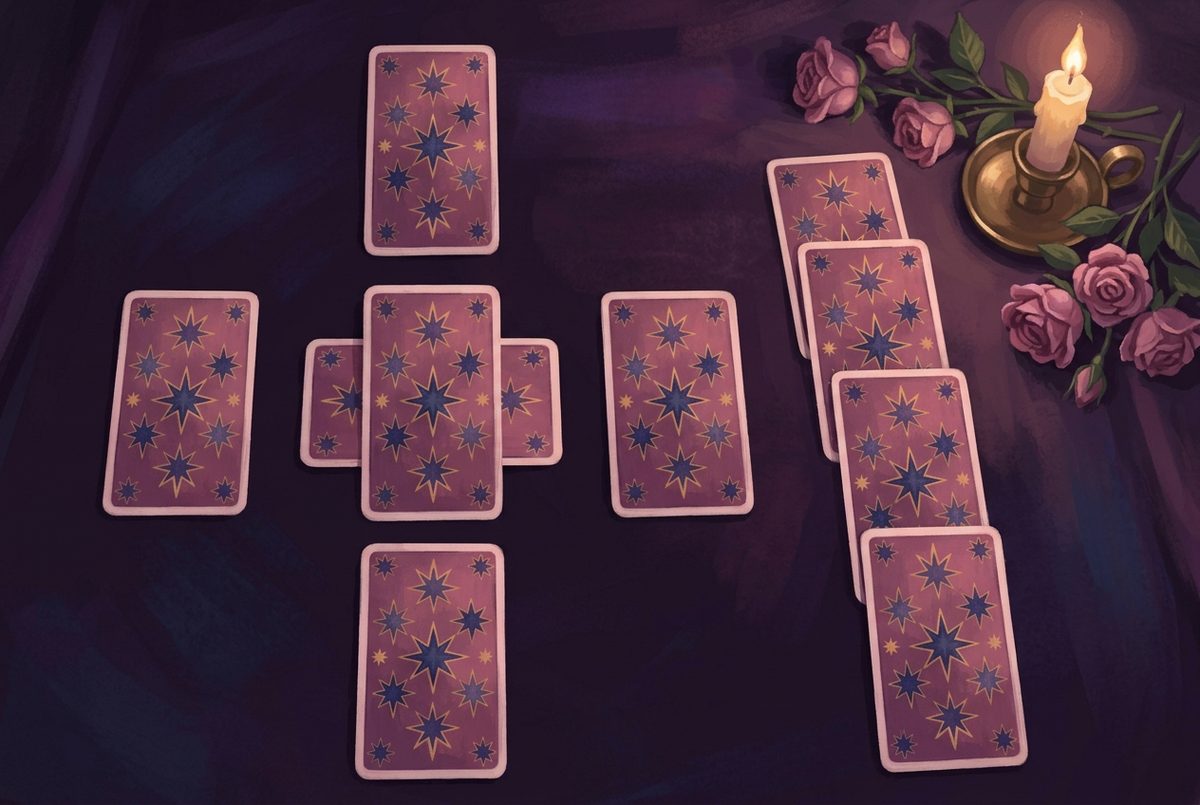
Some questions do not fit on a small table. The Celtic Cross is a ten card tarot spread that maps one situation from several angles at once: its root, its recent past, the thing crossing it, and its likely direction. It has been the standard big layout for over a century, and it earns that place by refusing to give you a single tidy answer.
Position names and their order shift a little between decks and teachers. That is fine. What follows is the common Waite derived set, and once you know why each spot exists you can adjust it without losing the thread.
When ten cards earn their keep
The Celtic Cross is for a situation, not a query. Something you have been carrying for a while. A relationship you cannot see clearly anymore, a decision that keeps changing shape, a stretch of work that feels heavier than it should.
If you want a quick read on one thing, use fewer cards. The three card spread handles most everyday questions and finishes in ten minutes. Ten cards on a small question just gives you eight cards of noise around the two that mattered.
You also want time. A Celtic Cross deserves a sitting. Somewhere to put the cards down, and enough quiet that you can look at position nine and be honest about it.
The cross, positions 1 through 6
The first six cards build the shape most people recognize. One card, another laid sideways across it, then four more around the pair.
- The present, the heart of the matter. This is the situation as it actually stands, not as you described it when you shuffled.
- The challenge, laid across the first card. What crosses it. Sometimes an obstacle, sometimes only a complication that keeps the situation from resolving on its own.
- The root, sitting below. What the situation grew from. This card is often older than the question, pointing at something that started long before the part you noticed.
- The recent past, what is just leaving. Useful because it tells you what you are still reacting to, even when it has mostly gone.
- What crowns the reading, above. The goal, or the best that is genuinely available from where you stand now. Not a promise. More like the ceiling of the room you are in.
- The near future. What is approaching next. Read it as the following chapter rather than the ending, because that is all it is.
A reversed card in any of these positions is not a warning. It is the same meaning turned slightly, asking you to look at it from a different side.
The staff, positions 7 through 10
The last four cards sit in a column beside the cross and are read from the bottom up. This is where the reading stops describing the situation and starts describing you inside it.
- You. Your own attitude as you come to the question. Often the most uncomfortable card, because you rarely see your own stance until it is face up on the table.
- Your surroundings. The people and circumstances around the situation. Note that this shows the shape of your environment, not what anyone in it is thinking. Cards cannot read another person's mind.
- Hopes and fears. Usually the same card wearing both faces at once, which is less strange than it sounds. The outcome you want most is often the one you are most afraid of.
- The likely direction. Where things tend if nothing changes. A forecast you are allowed to change, never a fixed outcome.
Reading positions in pairs
Ten separate meanings is a list. The spread only comes alive when you start reading cards against each other.
- 1 with 2: the situation and what crosses it. This pair alone often answers the question.
- 3 with 5: the root and the crown. Where this came from against where it could go. A wide gap between them usually means the goal needs revising, not more effort.
- 4 with 6: what is leaving and what is arriving. Read together, they show the direction of travel rather than two isolated moments.
- 9 with 10: what you hope and fear against the likely direction. When those two agree, you already knew. When they clash, position nine is usually the more honest card.
A short walkthrough
Say the question is about a job someone has stayed in too long. Not miserable, just stalled.
Position 1 comes up as the Eight of Swords: feeling far more stuck than the facts support. The situation is real, but the walls are closer in the telling than in the world.
Position 5, the crown, is Ten of Cups. That is worth pausing on. The best available outcome here is not a promotion or a title. What this person actually wants is a life that feels whole, and the job is only one part of it. The goal was never really about the job.
Position 7, their own attitude, is The Hermit. A stretch of deliberate quiet. They have pulled back to think, which is reasonable, though after a while stepping back becomes its own kind of staying put.
Position 10 is The Chariot. Momentum, and steering. Read against the Eight of Swords in the present, the direction is clear enough: the movement is available, and it depends on them doing the steering rather than waiting for the road to change. Nothing here predicts a resignation letter. It describes a person who already knows they can move, reading their own hesitation back to themselves.
Common mistakes
The most common one is reading ten verdicts instead of one story. Each card gets a paragraph, nothing connects, and you finish with a pile of impressions. Read the pairs first, then let the rest fill in.
The second is treating position 10 as settled. It shows where the current is running today. Change position 7, your own stance, and position 10 usually moves with it.
The third is reaching for ten cards when the question needed three. Pulling a full spread on "should I text him back" produces an enormous amount of material about a small moment. If you are unsure how much weight your question carries, it helps to look at how you phrased it before you shuffle.
Common questions
Is the Celtic Cross good for beginners?
It is workable, but not the easiest place to start. Ten cards means ten meanings plus the relationships between them, which is a lot to hold at once. If you know your card meanings reasonably well and are comfortable with three card readings, you can handle it. Take it slowly and read the pairs before attempting the whole picture.
How long does a Celtic Cross reading take?
Plan on twenty to forty minutes. Laying the cards takes two, but the reading itself needs time to breathe, especially the pairs and position nine. Rushing it produces a list of card meanings rather than an actual reading. If you only have five minutes, a smaller spread will serve you better than a hurried Celtic Cross.
Do I need a significator card?
No. The significator, a card chosen beforehand to represent the asker, comes from older versions of the spread and many readers have quietly dropped it. Position 7 already covers where you stand. If you like the ritual of choosing one, keep it. If it feels like an extra step, skip it and lay the ten cards as they come.
Sitting with it afterward
The Celtic Cross tends to leave you with more than you can process in one pass, and that is part of its value. Come back to it the next day and position nine will usually look different. If you want company while you turn a reading over, the Witch app is somewhere to think one through with a companion rather than alone with your notebook.