 Major Arcana · 7
The Chariot
- Control
- Determination
- Victory
- Journey
- Direction
- Will power
- Self-discipline
- Courage
- Confidence
- Assertiveness
- Progress
- Lack of control
- Inner conflict
- Delay
- Self-doubt
- Indecision
- Lack of discipline
- Reverse direction
- Defeat
What The Chariot means
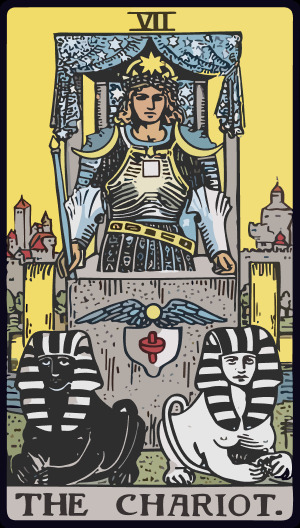
The Chariot card represents movement, journey, control and victory. It symbolizes the charioteer who drives his chariot forward, representing the conscious mind in control of the unconscious. This card can indicate that a person is in control of their life and are moving forward with determination and confidence.
The Chariot upright
The Chariot reversed
The Chariot upright is the moment when drive and discipline pull in the same direction at last. Two forces that used to fight each other, urgency and patience, doubt and nerve, finally answer to one steady hand. This is not about speed. It is about holding a steady course when the road gets loud. Confidence here is quiet, built from small wins stacked one after another. The card favors a decision already half made. Commit to it, and the momentum you have been chasing starts to move with you instead of against you.
The Chariot reversed can mean the two forces pulling you have stopped negotiating and started stalling each other out. Confidence wavers. A plan that felt solid last week suddenly needs rechecking, and doubt starts asking questions your nerve used to answer. Discipline has slipped somewhere, in rest, in focus, in plain follow-through, and the card asks you to find where. Pause before you force the pace. A steadier grip usually beats a harder push when momentum has stalled.
Is The Chariot a yes or no card?
Upright, The Chariot leans yes. Reversed, it leans no. How a yes or no reading works
The Chariot as advice
Focus and determination will lead to success. Take control of opposing forces.
Reconsider your direction. Lack of control and willpower may hinder progress.
The Chariot in a love reading
Pulled by two sphinxes that would happily head opposite ways, this card moves anyway, on willpower rather than reins. It often shows up when a relationship needs one clear decision more than a dozen small compromises, choosing a direction and actually committing to it. It can mark a stretch of real progress, moving in together, working through a hard patch, finally having the conversation you kept postponing. The pull here is forward motion through sheer will, not luck. Confidence matters as much as the plan itself, so hold your direction steadily.
The sphinxes stall when they pull against each other instead of together. This reversal can surface as indecision about a relationship, wanting two different things at once and not knowing which one to trust. It might show up as delay, the conversation you keep meaning to have, the decision you keep circling without landing on. Old doubts can resurface here too, the kind that make you question your own judgment more than the actual situation calls for. Slowing down is not the same as losing ground. Steady your own direction first, then move.
The Chariot in a career reading
The Chariot in a career reading favors momentum built on your own steam, not a lucky break. Something you have been steering toward finally gets traction, a project, a promotion push, a business plan that stops living in your head. The card asks for one clear direction rather than three half-committed ones. Say no to the detours. Confidence reads as competence here, and people notice when you stop hedging and start driving the work forward. Discipline, not talent, is what carries this stretch. Keep both hands on it and the pace holds.
The Chariot reversed at work can describe effort split between competing priorities, a main job and a side project, ambition and exhaustion, with neither one actually advancing. Deadlines slip. Decisions that used to feel obvious now stall in your hands. Something in your discipline has come loose, maybe rest, maybe focus, and it is worth naming before the next push. Pick one direction this week. Even a short, honest step forward beats staying split between two half efforts.

Element
Water symbolizes emotion and intuition, driving The Chariot's controlled movements.

Planet
Mars embodies drive, determination, and action, mirroring The Chariot's forward momentum.

Zodiac
Cancer represents protective and forward-moving energies, similar to those of The Chariot.
Crystal
Red jasper provides strength and endurance, aiding The Chariot's journey.
Symbolism of The Chariot
The Charioteer is shown with a canopy of stars, symbolizing celestial influences, and the two sphinxes represent the opposing forces he must control. The city behind indicates the culmination of a journey, and the square on his tunic represents the Earth and material world, over which he has mastery.