Fifty six of the seventy eight cards in a tarot deck belong to a suit. That is most of the deck, and it is the part beginners tend to skip, because the Major Arcana has the famous names and the big pictures. The suits are quieter. They are also where most of a reading actually happens.
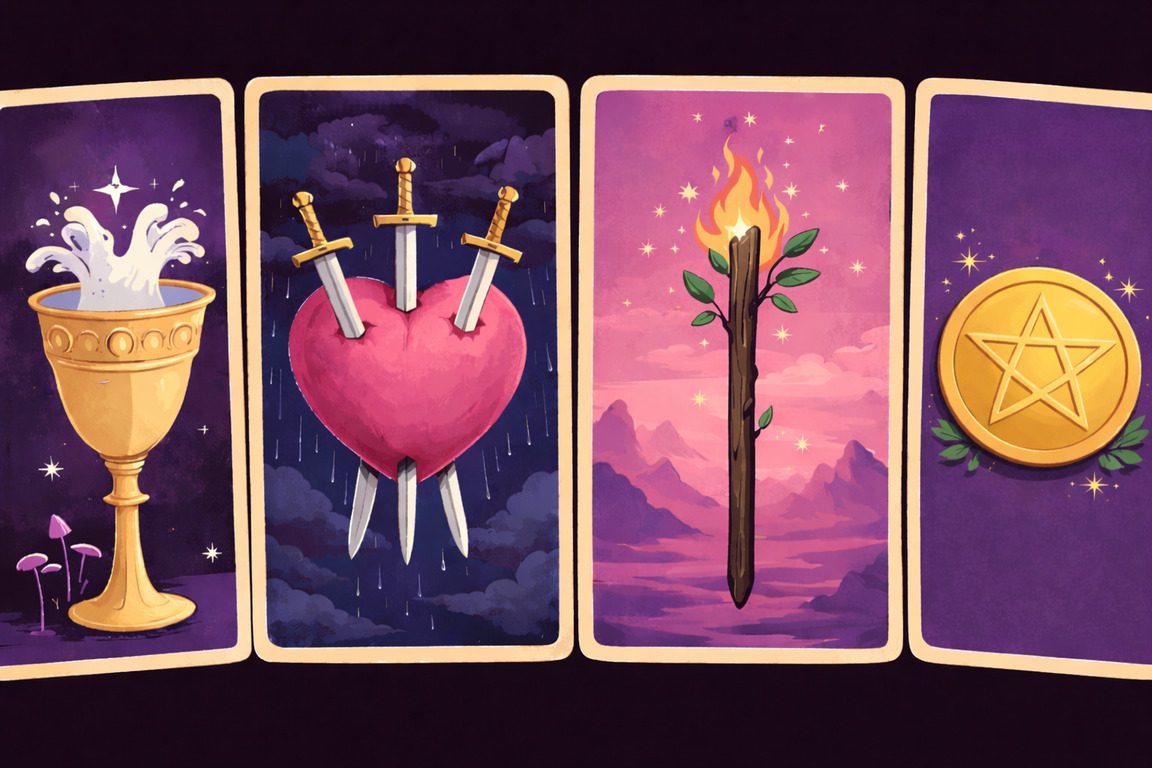
The four suits are Wands, Cups, Swords, and Pentacles. Each one is tied to an element, and each carries a theme. Learn the four themes and you already have a rough sense of what any card in that suit is about, before you look up a single meaning.
The four tarot suits and their elements
Every suit runs from Ace to Ten and then adds four court cards, which makes fourteen cards per suit. The elements are the fastest way in.
- Wands go with fire. The theme is drive, ambition, and creative work.
- Cups go with water, which covers feelings and relationships.
- Swords belong to air. They deal with thought, conflict, and the moment something becomes clear.
- Pentacles are earth cards, about work, money, the body, and home.
A suit tells you which area of life a card is talking about. It does not tell you whether the news is good. Suits are themes, not verdicts. A Swords card in a spread about your job is pointing at the thinking around the job, not handing down a ruling on it.
Wands and the fire theme
Wands cover the part of you that wants to start something. Ambition, creative work, the pull toward a project you cannot stop thinking about. When a Wands card turns up, the question usually has something to do with motivation, or with an initiative already in motion.
The Ace of Wands often reads as a new idea worth following. The Eight of Wands tends to appear when things are moving quickly and there is little time to deliberate. Neither card promises the project will work. They describe what the wanting feels like right now.
Cups and the water theme
Cups are the feeling suit. Love, friendship, family, the way you attach to people and the way you grieve them. A Cups card usually means the question has an emotional center, even if you framed it as something practical.
The Two of Cups often points to a connection between two people and what passes between them. The Five of Cups tends to arrive when attention has settled on what was lost rather than what is still here. Cups cards are rarely about the facts of a situation. They are about how it landed.
Swords and the air theme
Swords are thought made visible. Beliefs, arguments, the sentences you rehearse before a hard conversation. This suit also carries conflict, which is why it has such a heavy reputation, though the conflict is often between two things you believe at the same time.
The Ace of Swords reads as the moment something becomes clear, sometimes uncomfortably so. The Three of Swords usually concerns hurt that arrived through words, or through finding out the truth. A difficult Swords card is not a punishment. It shows you where the thinking is sore.
Pentacles and the earth theme
Pentacles handle the material side of a life. Work, money, the body, the home, and everything that has to actually get done. These cards are slower than the rest of the deck. They deal with things that take time to build.
The Four of Pentacles often shows a tight grip on what you already have, which can read as security or as fear depending on what sits around it. The Ten of Pentacles points to something built to last, usually family or long stability. When Pentacles dominate a reading, the question has a practical answer somewhere inside it.
Where the Major Arcana fits
The remaining twenty two cards are the Major Arcana, and they sit outside the suits. These are the bigger themes and turning points, the parts of a life you look back on later and treat as a chapter break. The sequence runs from The Fool at the beginning to The World at the end.
The Lovers can mean a relationship, or a choice that says something about your values. The Hermit is time spent alone on purpose. Death is almost never literal. It marks the close of one phase and the opening of whatever comes after it.
Using the elements as a shortcut
Here is the trick that keeps you reading when memory fails you. If you cannot recall what a card means, take the element of its suit and combine it with its number. The element plus the number gets you close enough to keep going.
Take the Two of Pentacles. Earth is work, money, and the practical day. Two is a pair, a balance, two things held at once. Put those together and you get juggling two practical demands while trying not to drop either one. That sits very near the traditional meaning.
Or the Ace of Cups. Aces are beginnings, the first moment of something. Water is feeling and connection. So the Ace of Cups becomes the start of something felt, a new closeness or an old one softening. Close again, without a single memorized definition.
This works because the deck is built on a system rather than on seventy eight unrelated facts. The exact meanings settle in later, mostly on their own, once you have read with the cards for a while.
Reading tarot suits across a spread
Once the cards are on the table, the mix of suits says something before you read any of them in detail.
- A spread heavy in Swords suggests the situation is living in your head. Replayed conversations, arguments you have already had with yourself.
- Mostly Cups means the question is emotional, whatever you asked out loud.
- A run of Pentacles points at the practical layer, so money, work, health, or the room you are sitting in.
- Plenty of Wands says there is momentum somewhere, or a strong wish for some.
- Several Major Arcana cards suggest something larger than this week is in play.
What is missing matters too. If you asked about a job and no Pentacles showed up, the money side may not be where the real tension sits. Witch can talk a spread through with you, though the sense you make of it stays yours. Read the mix first, then the individual cards, and the second pass usually goes faster.
Common questions
What do the four tarot suits mean?
Wands are fire, covering drive, ambition, and creative work. Cups are water, so feelings and relationships. Swords are air, which brings thought, conflict, and clarity. Pentacles are earth, meaning work, money, the body, and home. Each suit holds fourteen cards, and each one names a theme rather than a verdict.
Do I have to memorize all fifty six minor arcana cards?
No. Start with the four elements and with what the numbers do. Element plus number gets you close on most cards, and it gets you closer every time you sit down with the deck. The specific meanings arrive later without much effort.
Is one tarot suit better than the others?
No suit is better or worse than another. Swords carry the roughest reputation because they hold conflict, but a Swords card about a hard conversation is showing you where clarity is available if you want it. Reversed cards work the same way. They ask you to look at a card more slowly, not to read it as bad news.