
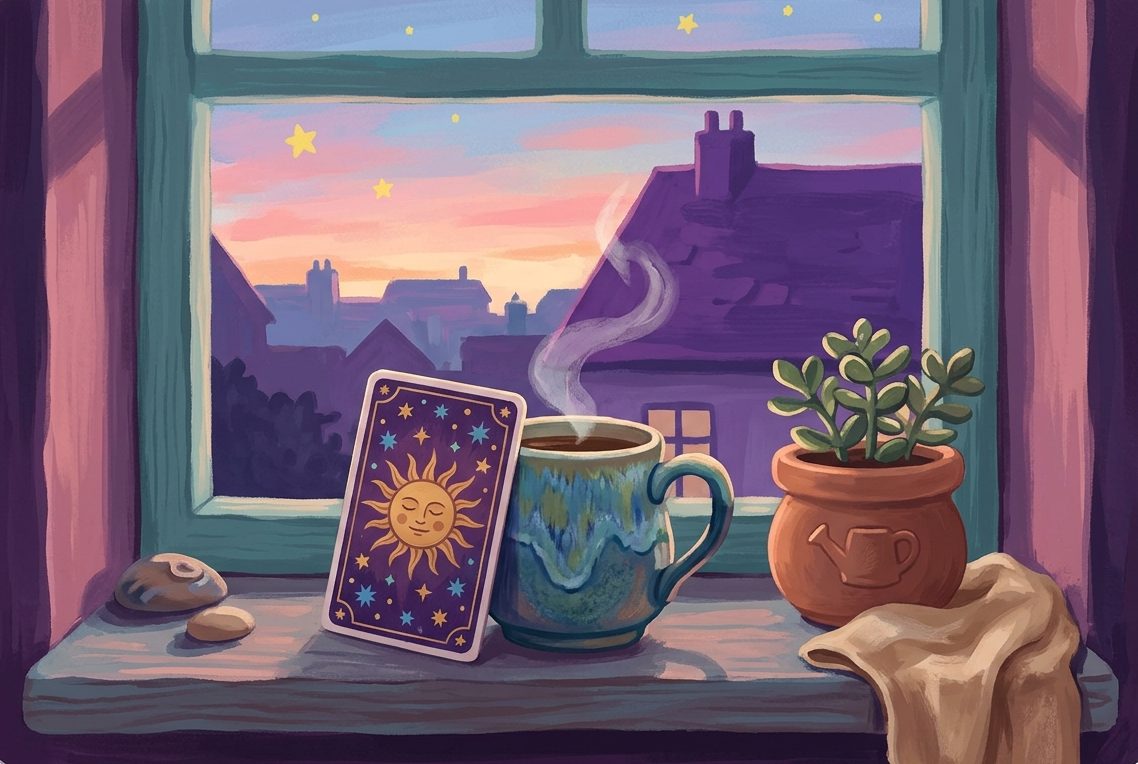
Most mornings arrive already talking. A daily tarot card is one card drawn each morning and read as a lens for the day ahead, not a prediction of what the day will contain. It gives you one image to hold while everything else gets loud. The practice is small on purpose. One card, a minute or two, and then the rest of your life.
People often quit this habit around week three. Not because it stopped working, but because it turned into a chore with no shape. Here is how to build one that keeps breathing.
How to draw a card of the day
Pick a moment that already exists in your morning. While the coffee brews. Before you open your inbox. An anchor you already have beats a new slot you have to defend.
Then keep it short.
- Shuffle for as long as it takes to arrive in the room. Ten seconds is fine.
- Draw one card. Not two, not one plus a clarifier.
- Look at it. Say what you notice out loud or under your breath.
- Write one line, if you write at all.
Under two minutes is the goal, because two minutes survives a bad week and fifteen does not. The days you least want to sit down are usually the days worth marking.
One card is the whole point. If you keep pulling a second card to explain the first, you are asking a bigger question than a daily draw can hold. That is worth noticing.
How to read one card for a whole day
The mistake is asking the card what will happen. It cannot tell you that. No card knows whether the meeting goes well or what your sister is thinking.
Ask instead what to keep an eye on. The card becomes a question you carry, and the day answers it.
Turning a card into a question is simpler than it sounds. Take the Three of Swords, a card about grief and hard truth. The prediction reading would be "something painful happens today." The useful reading is a question: where am I bracing against something I already know? Sometimes nothing surfaces. Sometimes you notice, around four in the afternoon, that you have been avoiding one specific message all day.
That is what the card did. It did not cause anything. It gave you somewhere to look.
Reversals work the same way if you use them. A reversed card is not a bad card and nothing is barred. It usually asks you to turn the same theme inward, or to look at it more slowly. If reversals feel like extra homework, read every card upright. That is a perfectly ordinary way to work.
Three cards, three kinds of day
Three examples, read as themes rather than forecasts.
The Fool is a day for starting the thing before you feel ready. It carries beginnings and a certain willingness to look foolish. Drawn on a morning when you have been researching instead of doing, the question becomes obvious. What would I open right now if I stopped preparing?
The Star tends to arrive on steadier ground. It speaks to hope, quiet repair, and faith that has been rebuilt rather than handed to you. As a daily card it rarely means anything dramatic. It asks what you have been slowly putting back together, and whether you have given yourself any credit for it.
The Page of Pentacles is a day for small diligent steps. Pentacles hold work, money, and the body, and the Page is the student of that suit. It nudges toward the boring useful thing. Learn something by hand, do the twenty minutes. To sit with more cards this way, the card meanings library has all seventy eight.
Journaling without making it a project
Two or three lines a day is enough. Long entries are the fastest way to make a daily practice collapse under its own weight.
Some prompts that hold up over months:
- What did this card seem to be about this morning?
- What did it actually touch by evening?
- One thing I noticed today that I would not have noticed otherwise.
Write the morning line in the morning and the evening line in the evening, if you can. The gap between them is where the practice lives.
The real value shows up later. Rereading a week of entries teaches more than any single reading, because patterns are invisible one day at a time. You will see the same worry surface on Tuesdays. You will see three cards about work in a row during a month you told yourself was fine. That is information you gave yourself, slowly, in small pieces.
When the same card keeps returning
It feels uncanny the first time. The Eight of Cups turns up four times in ten days and it starts to seem like the deck is trying to reach you.
Two honest things are true at once. Repetition in a shuffled deck is more common than intuition suggests, so some of this is just how randomness looks up close. And the cards you notice are the ones that already have a hook in you. Nobody remembers the fourth Two of Wands.
So treat a repeating card as a flag on your own attention. Something in your life is unresolved enough that this theme keeps finding purchase, and that is worth an evening. Give it more room than a daily draw allows. Ask a real question and lay out a three card spread for it, or write about the card without drawing anything at all.
When the practice goes quiet
At some point the cards start to blur. You draw, you glance, you file it, and nothing happens. Every daily practice does this.
You are allowed to pause. A week off is not a failure, and coming back after a month is still coming back. Forcing a habit that has gone hollow only teaches you to ignore it.
A few things that tend to revive it:
- Change the time. An evening draw asks a different question than a morning one.
- Read the card cold before looking anything up, then check the meaning after.
- Stop journaling for two weeks and just look.
- Give the practice a season rather than forever. Thirty days, then decide.
Sometimes it has not gone stale, it has only outgrown its container. If your questions have gotten bigger than one card, that is a good sign. Closed questions with a yes or no shape are better served by a yes or no draw, and tangled ones want more cards and more time.
Common questions
What time of day should I draw my daily tarot card?
Morning suits most people, because the card has a whole day to prove useful. But the best time is whichever one you will actually keep. Some readers draw at night and read the card backward across the day that just ended, which works well if mornings are chaotic. Consistency matters more than the hour. Pick a moment already in your routine and attach the draw to it.
Should I read my daily card upright and reversed?
Either way is valid. Reading everything upright is common and keeps a daily practice light, especially when you are learning. If you do use reversals, remember they are not negative versions of a card. A reversed card usually asks you to look at the same theme from a different angle, or turned toward your inner life rather than outward. Choose one approach and stay with it for a while.
What if my daily tarot card seems bad?
No card predicts a bad day, because cards do not decide what happens. Difficult cards name difficult themes, and naming one early is often useful. The Tower points at something already unstable. The Five of Pentacles points at a felt lack. Read it as a place to pay attention rather than a warning, and check whether it describes something you already suspected.
Keeping it going
A daily card gets more interesting the longer you keep it, mostly because you are the one accumulating. The Witch app has a daily card draw and a home screen widget showing your card of the day, so the practice sits where your eyes already go.