
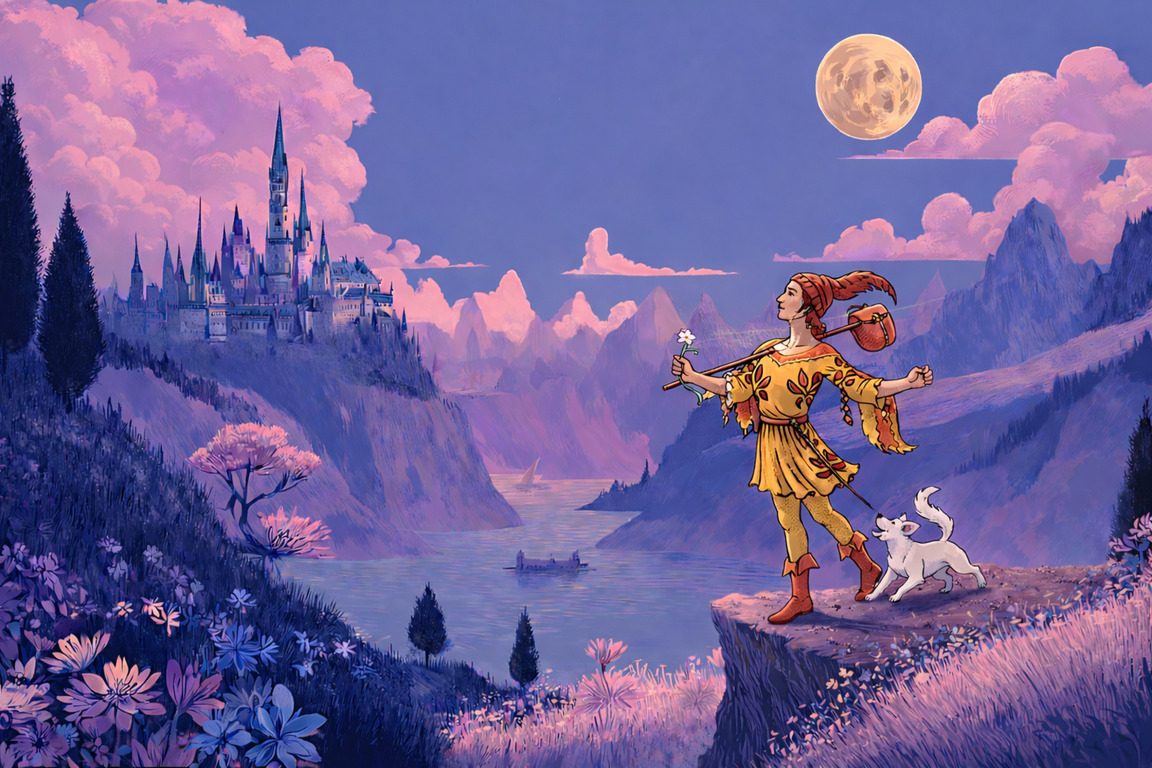
Most tarot decks on sale today are descendants of a single deck. The proportions, the full scene on every card, the habit of letting a picture carry the meaning instead of a number, all of it traces back to the Rider Waite tarot deck, published in London in 1909. Learn that one well and you can pick up almost any other deck and already know roughly what you are looking at.
The two people behind the Rider Waite tarot deck
Arthur Edward Waite was a British scholar and a member of the Hermetic Order of the Golden Dawn. He had spent years reading and writing about symbolism, and he thought tarot deserved better than the reputation it carried at the time. Tarot was mostly treated as a card game or a fortune telling prop. Waite wanted a deck built for reflection and self understanding instead.
He could supply the structure and the meanings. The pictures were another matter, so he commissioned Pamela Colman Smith, an artist and a fellow member of the Order. Waite gave her the framework. Smith gave the deck its face.
Pamela Colman Smith did more than illustrate
Smith painted all 78 cards. For the minor arcana she had little to work from, because almost no earlier deck had given those cards scenes. Waite's notes pointed at meanings. Smith had to decide what a meaning looks like when a person is standing in a field holding a cup.
Those decisions are what people actually read when they read tarot. When you look at the Ten of Wands and feel the weight of what that figure is carrying, you are reading Smith. When the Eight of Cups feels like a quiet departure rather than a disaster, that is Smith's staging.
For decades her name was left off. The deck was sold and discussed as the Rider Waite deck, crediting the publisher and the author while the woman who painted every card went unmentioned. That has been shifting. The deck is increasingly called Rider Waite Smith, and the fuller name is the one worth using.
What made the Rider Waite tarot deck different
The deck was published in 1909 by the Rider Company in London. Major arcana cards had always been illustrated. In nearly every deck that came before, the minor arcana were pips. Six cups meant six cup shapes arranged on the card, much like the six of hearts in a deck of playing cards. To read them you needed a memorized system, usually numerology combined with the theme of the suit.
Waite and Smith illustrated all 78. Every card became a small scene with people in it, with gestures and objects placed on purpose. That single choice is the reason this deck matters more than any refinement of its symbolism.
Why full scenes changed how people learn tarot
With a pip card, you have to recall what the number and the suit mean together before anything happens. With a scene, you can start by describing what you see. A beginner who draws the Five of Pentacles can say that two people are out in the snow, passing a lit window, and already be most of the way to the card. Nothing had to be memorized first. The picture did the teaching.
This is why it became the standard teaching deck. It brought the entry cost of tarot down from months of study to an afternoon of looking carefully. It also changed what a reading feels like. Cards stopped being values to decode and became situations you could recognize, which makes it far easier to connect one to something happening in your own life.
Scenes also make the cards easier to hold as themes rather than verdicts. The Five of Pentacles is not a ruling handed down about your finances. It is a picture of two people who are cold and have not noticed the light beside them, and what you take from that depends on what you brought to the reading.
The layer underneath the pictures
There is a second layer beneath the surface of each scene. Waite drew on Christian mysticism, astrology, Kabbalah, and older mythology, and Smith worked those references into the composition of the cards. Colors repeat across the deck, and so do certain objects and settings.
You can read these cards for years without chasing any of that, and plenty of people happily do. The layer sits there for whenever you want it. The Fool's step off the cliff and the World's closing circle are the two ends of a sequence the major arcana walks through, and once you notice the shape of it, the order of the cards stops feeling arbitrary.
A slow start, then a long second life
The deck did not sell its way to fame. It was published, it circulated among people already interested in tarot, and it stayed fairly quiet for decades. The wider audience arrived in the 1970s, when the New Age movement brought tarot to far more people than had ever handled a deck before. The Rider Waite Smith cards were already there, already illustrated, already easy to learn from.
From that point it became the most widely used tarot deck in the world and the reference point for nearly every deck designed since.
What this means if you are choosing a deck today
If you are buying a first deck, the useful question is not which one is prettiest. It is which one will still make sense to you in six months, on a difficult evening when you want the cards to speak plainly.
Most modern decks keep the Rider Waite Smith structure underneath their artwork. They use the same 78 cards and the same suits, and usually the same scene on each minor card reinterpreted in a new style. Decks like this are often described as Rider Waite Smith based, which means your learning transfers. A book or a card meaning written for one will line up with the card in your hand.
Some decks break from the tradition on purpose, renaming suits or restructuring the majors, and several of them are lovely to read with. They are also easier once you have a baseline to compare them against. Learning this imagery first gives you that baseline, and switching later costs you very little.
Common questions about this deck
Why is it called the Rider Waite deck?
Rider was the publisher. The Rider Company printed the deck in London in 1909, and the publisher's name stuck to it the way publisher names sometimes do. Waite is Arthur Edward Waite, who designed the structure and the meanings. The name missing from that pair is Pamela Colman Smith, who painted every card, which is why Rider Waite Smith is becoming the more common way to refer to it.
Is this a good deck for beginners?
Yes, mostly for one reason. Every card carries a scene you can describe out loud, so you can begin reading before you have memorized anything. Nearly all beginner material assumes this deck as well, so when you look a card up, the description will match what you are holding.
Do I need an original version, or is a reprint fine?
Any faithful edition works. There are recolored and restored printings with different palettes and card stock, and the imagery in them is the same. Pick the one you like looking at, because you will be looking at it a great deal. Reading from a screen works the same way, as long as the images are the ones you have learned.
Reading with a deck this old
A card from 1909 knows nothing about your week. What it has is a picture that people have been looking at, and arguing about, for over a century, which makes it a good surface to think against. You draw a card, you describe what you see, and then you notice which part of it you keep returning to. Witch reads this way too. You share what is on your mind, and the two of you make sense of the card together, without anyone pretending to know how things turn out.