
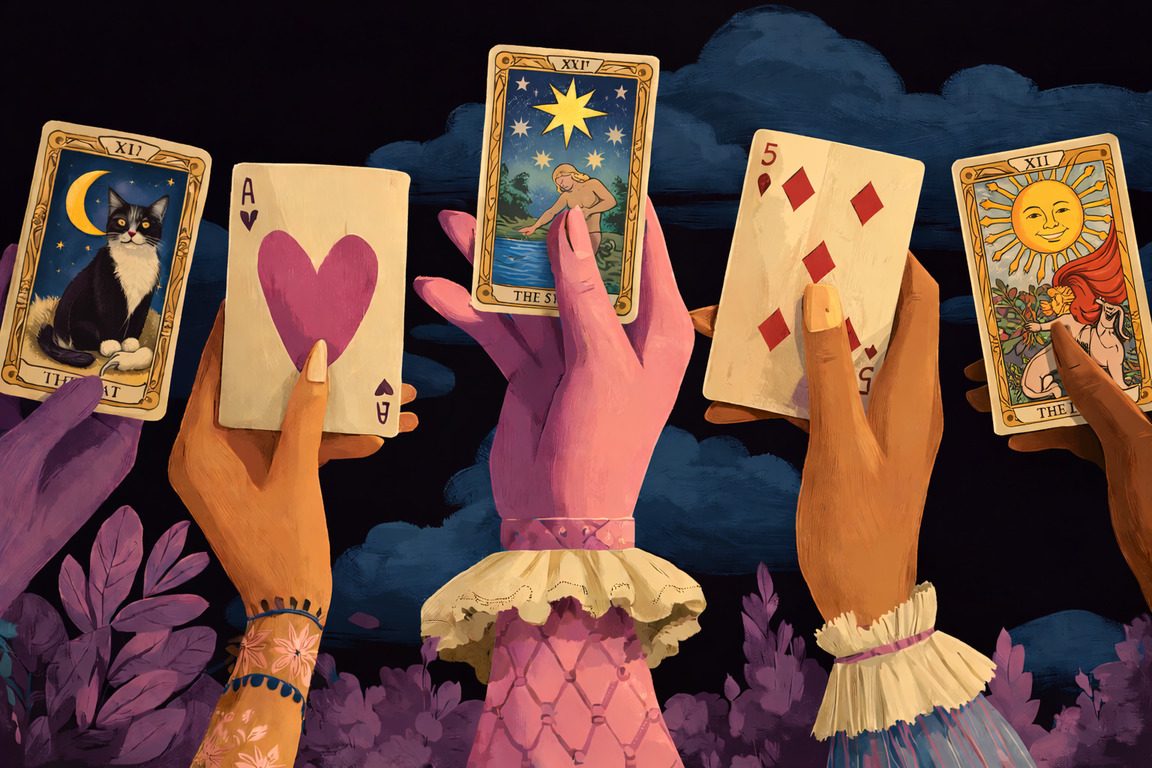
The oldest tarot cards that still survive were painted by hand for a wealthy Italian family. They were not made for a fortune teller. They were made for a card game. Tarot began in 15th century Italy as a game called tarocchi.
That detail surprises most people, and it changes how the rest of the story reads. Tarot did not arrive as a finished system of meaning that someone later rediscovered. It started as entertainment, picked up symbolism along the way, and only much later became something people used to think about their own lives.
Where the history of tarot actually starts
Playing cards reached Europe before tarot existed. They arrived around the 14th century, though the exact route is not fully settled. One clear ancestor is the Mamluk deck, which came out of the Islamic Mamluk Sultanate and held 52 cards covered in ornate designs. Set it beside a modern deck of playing cards and you would spot the family resemblance right away.
There are no trump cards in it. None of the images people picture when they think of tarot were there yet. Just suits and numbers, made for play.
So the first thread in this story is an ordinary one. People liked a card game, the game traveled, and the design traveled with it.
The Italian courts and a game called trionfi
The tarot that we recognize took shape in Italy in the mid 15th century. A new card game appeared there called trionfi, meaning triumphs. It used a deck of 78 cards, and 22 of those were special trumps that outranked everything else in play. Those 22 became what readers now call the Major Arcana. The Italian name for the game was tarocchi, and that is where the word tarot comes from.
The trump cards carried allegorical pictures, the kind of philosophical and moral imagery that educated Italians of that era would have recognized on sight. These were not secret symbols. They were the visual vocabulary of the day, the way a modern audience reads a heart or a lightning bolt without needing anyone to explain it.
The Visconti-Sforza deck is one of the earliest known tarot decks that still exists. It was made in the 1440s for the family of the Duke of Milan, painted one card at a time for people who could afford that kind of thing. It gets studied closely because it shows what the images looked like before anybody had attached a divinatory meaning to them.
When people started reading the cards
For roughly three centuries, tarot stayed a game. The shift came in the 18th century, when scholars and mystics began looking at the pictures and asking what else they might hold.
The most influential of them was the French occultist Antoine Court de Gébelin. In his book Le Monde Primitif, he argued that the tarot was a survival of ancient Egyptian wisdom, a book of universal secrets disguised as a deck of cards. The claim did not hold up. It was a romantic idea, though, and it spread fast.
What followed mattered more than the claim itself. Occultists like Éliphas Lévi, and later the members of the Hermetic Order of the Golden Dawn, took the deck seriously as a symbolic language. They layered Kabbalistic and astrological correspondences onto the cards, along with ideas borrowed from alchemy. They worked out how the cards related to one another and built the interpretive framework that most readers still use in some form today. Much of what looks like ancient tarot tradition was written down for the first time in this period.
The Egyptian origin story, gently corrected
If you have heard that tarot came from Egypt, you are in good company. It is one of the most repeated claims anyone makes about the deck, and it has been repeated for more than two hundred years.
Modern scholarship has debunked it. The trail of evidence runs backward from today's decks to Renaissance Italy and stops there. There is no older Egyptian deck sitting behind it, and no hidden lineage waiting to be recovered. The Egyptian story was invented in the 18th century by writers who admired Egypt and wanted the cards to be older and stranger than they actually were.
Knowing that takes nothing away from the deck. A set of images does not need an ancient pedigree to be worth sitting with. Tarot has been carrying meaning for people for hundreds of years, which is a real history, and it has the advantage of being the one we can actually document.
The deck most readers know today
The next big change came in 1909, when the Rider-Waite-Smith deck was published. The British occultist A.E. Waite designed it, and the artist Pamela Colman Smith drew it.
Their idea sounds small and turned out to be enormous. Before this deck, the numbered cards in the four suits were usually shown as plain arrangements of cups or coins, closer to the pips on a modern playing card. Smith illustrated all 78 cards with full scenes instead. Suddenly the Five of Cups showed a cloaked figure standing over spilled cups, and you could read something from the picture before you knew a single traditional meaning.
That one decision is why tarot became learnable at home. A beginner could pick up the deck and get somewhere on intuition alone. Most decks published since either borrow Smith's compositions or deliberately push against them, which is its own kind of influence.
What this history changes about your own readings
Once you know the timeline, one thing becomes hard to unsee. The meanings did not arrive fixed. They grew.
The images came from a card game. The interpretations came from centuries of people sitting with those images and noticing what they brought up. Waite and Smith made a set of choices in 1909. The Golden Dawn had made different ones before them. Readers have been adjusting ever since. There was never an original master key handed down intact.
That is good news for anyone learning. Your own reading of a card belongs to the same long process that produced the traditional meanings in the first place. When the Tower comes up and your first thought goes to a situation you have been quietly dreading, that thought is worth more than a memorized keyword. The deck has always worked as a mirror, and a mirror needs someone standing in front of it.
It also explains why tarot does not predict anything. The cards were never built to know what happens next. They are a collection of recognizable human situations, painted by people, arranged so you can look at your own life through them. What you make of what you see stays yours.
Common questions about the history of tarot
Where did tarot cards come from?
Tarot cards came from 15th century Italy, where they were created for a card game called tarocchi. The 78 card structure with 22 trumps was part of that game's design, not a mystical blueprint. Playing cards had reached Europe earlier, around the 14th century, with the Mamluk deck as one clear ancestor. Reading the cards for insight came much later, in the 18th century.
Are tarot cards Egyptian?
No. The Egyptian origin story was popularized in the 18th century by Antoine Court de Gébelin, and it has been repeated ever since, but the evidence points to Renaissance Italy. It is a lovely story and an untrue one. The documented history is interesting enough on its own.
Is the Rider-Waite deck the original tarot?
No, though it is the deck most people picture. It was published in 1909, more than four centuries after the earliest known tarot decks. What made it dominant is that every one of its 78 cards carries a full illustration, which made the deck far easier to learn from than anything that came before it.